When docks are congested and delivery windows keep shrinking, a well-designed truck loading conveyor becomes the quiet engine behind on-time shipping. Instead of relying on manual lifting and long walking distances inside trailers or containers, these systems bring the flow of goods right to the operator—cutting touches, reducing strain, and unlocking higher throughput. From express delivery hubs to cross-border e-commerce facilities and traditional warehouses, the right conveyor transforms loading and unloading into a predictable, safe, and scalable process.
What Is a Truck Loading Conveyor and How It Works
A truck loading conveyor is a specialized material handling system designed to move cartons, parcels, sacks, or other unit loads directly into or out of trucks, trailers, and containers. The most recognizable type is the telescopic belt conveyor—an extendable “boom” that glides deep into the vehicle. Operators stand safely at the dock, adjust the boom to the correct height and reach, and place or retrieve goods as the belt carries items in a continuous stream. Flexible roller or skate-wheel conveyors often connect upstream, allowing products to queue and flow smoothly from packing or sortation areas to the dock door.
Beyond telescopic belts, there are several configurations tailored to different loads and layouts. Gravity roller lines provide a cost-effective solution for stable cartons. Powered roller systems add control for heavier or uneven items. Incline belts bridge floor level differences, while mobile “dockless” booms serve facilities without permanent dock doors. Frames are typically heavy-duty steel, while belts can be chevroned or high-grip to prevent slippage. For demanding environments, options include flame-retardant belts and sealed components with higher ingress protection.
Performance centers on consistent flow and ergonomic handling. Modern vehicle loaders feature variable speed drives, soft starts, and responsive controls to match pace with upstream processes. Photo-eyes and accumulation logic manage spacing, preventing overloading and product collisions. Intuitive HMIs give operators quick access to extend/retract, lift/lower, and start/stop, while PLC-based controls standardize behavior across lanes. The result is fewer manual steps: goods enter the vehicle in sequence, travel distance shrinks dramatically, and fewer people are needed inside trailers—an immediate win for both productivity and safety.
Safety is engineered into every touchpoint. Emergency stop cords run along the conveyor sides, guarding shields minimize pinch points, and entry/exit lighting improves visibility inside dark trailers. Audible/visual alarms signal movement, and anti-rollback functions add extra control on inclines. Together, these features help ensure loading speed never compromises operator well-being—an essential requirement in fast-paced express delivery and industrial environments.
Key Benefits for Warehousing, Express, and Cross-Border Logistics
The most immediate benefit of a truck loading conveyor is higher throughput with fewer touches. By moving goods mechanically instead of manually carrying them, facilities often see loading/unloading cycle times fall dramatically. Depending on layout and product mix, it’s common to boost packages-per-hour by 30–60% while trimming the number of operators needed per door. That often translates to shorter queues at docks, more trucks processed per shift, and fewer bottlenecks bleeding into upstream processes like picking and sortation.
Ergonomics is just as crucial. Manually carrying cartons up and down trailers is one of the most fatigue-inducing tasks on the dock. A conveyor reduces lift frequency, awkward postures, and long walking paths, which can cut strain-related incidents and lower absenteeism. Over time, improved ergonomics helps stabilize teams, especially in regions where labor is tight and turnover spikes during seasonal peaks.
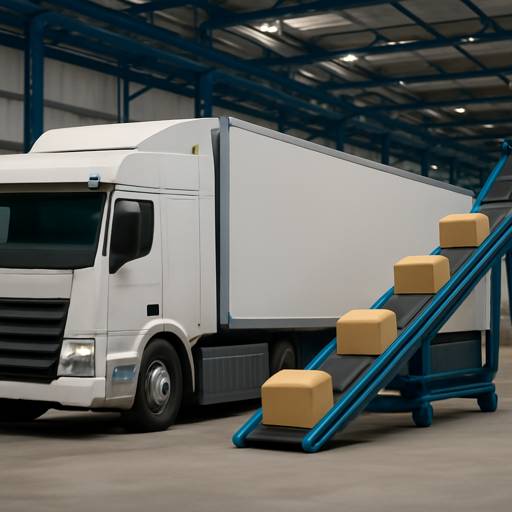
For express and cross-border operations—where variability rules—flexibility is a strategic advantage. Telescopic booms and mobile units adapt to mixed fleets, from last-mile vans to 40-foot containers and 53-foot trailers. Operators can raise, lower, and extend the boom to meet each vehicle’s geometry, then retract it instantly for the next load. With powered roller spurs feeding multiple dock positions, a single system can handle outbound parcels in the morning and inbound returns in the afternoon without a reconfiguration marathon.
Reliability and product protection also improve. Smooth, controlled conveying reduces drops and crush damage, important for electronics, cosmetics, and other high-value items that dominate cross-border e-commerce. Integrated scanning, weighing, and dimensioning at upstream stations feed data into WMS/WCS platforms, ensuring each item is visible and traceable as it passes to the dock. Many facilities report tighter inventory accuracy and cleaner handoffs to carriers because goods move in an orderly cadence rather than in rushed, last-minute sprints.
Cost is where the business case closes. Consider a site replacing heavily manual loading across two shifts: saving three to five full-time equivalents at typical dock wages can bring payback in 12–18 months, even before considering reduced damage claims and overtime. Modern drives consume less energy per shipped unit than forklifts shuttling into trailers. Sleep modes and sensor-based start/stop logic further minimize idle consumption, improving both sustainability metrics and operating budgets.
How to Choose the Right System: Features, Options, and Implementation Tips
Start with the loads. Parcels, totes, soft bags, and tires behave differently on a conveyor, influencing the choice between belt, roller, or mixed technologies. Heavier or deformable items favor belts with higher-friction covers; uniform cartons can excel on powered rollers with zone control. Next, match the extension length and elevation. For 40-foot containers or 53-foot trailers, look for telescopic booms that reach deep without sacrificing stiffness or stability. Height-adjustable booms and articulating discharge hoods help target the “golden zone” for ergonomic handling at every layer.
Capacity and speed matter, but so does control. Evaluate variable frequency drives, smooth acceleration, and accumulation logic to keep flow predictable through peaks. Lighting at the boom head, integrated fans for airflow in hot climates, and clear operator interfaces make real differences in daily use. Mobility is another factor: dockless vehicle loaders on heavy-duty casters or rail-guided bases can serve multiple doors, while compact flexible conveyors weave through tight aisles and reconfigure in minutes.
Safety and compliance should be non-negotiable. Seek CE/OSHA-aligned guarding, emergency stop cords, lockout/tagout provisions, and low-noise operation where possible. For busy express depots, add photo-eye interlocks that pause movement when operators step into safety zones. In environments with dust or humidity, confirm ingress protection ratings and specify corrosion-resistant finishes. A robust preventive maintenance plan—daily visual checks, belt tracking, lubrication intervals, roller inspection, and spare parts availability—keeps uptime high and surprises low. Remote diagnostics and event logs help maintenance teams resolve issues before they affect a departure schedule.
Implementation is where great hardware meets great process. A thorough site survey should assess dock geometry, floor flatness and load capacity, upstream conveyor heights, and power availability. Pilot a single lane to refine SOPs, then roll out consistently across doors. Train teams on ergonomic picking sequences inside the trailer, not just on pushbutton operation. Finally, evaluate total cost of ownership, including energy use, maintenance, and productivity impacts—not only purchase price. When comparing vendors, prioritize proven reliability, strong local service coverage, and upgrade pathways for future automation like barcode tunnels or automated sorting spurs.
For operations modernizing multiple docks or expanding cross-border capacity, reviewing a diverse product line speeds selection. Explore options—from telescopic belts to flexible roller systems—under one roof by researching a truck loading conveyor portfolio that spans express, warehousing, and industrial unloading scenarios. Matching the right platform to your product mix, fleet variety, and growth roadmap ensures the system you choose today will keep pace with tomorrow’s volumes.

Ankara robotics engineer who migrated to Berlin for synth festivals. Yusuf blogs on autonomous drones, Anatolian rock history, and the future of urban gardening. He practices breakdance footwork as micro-exercise between coding sprints.